> For the complete documentation index, see [llms.txt](https://docs.xplorpay.com/llms.txt). Markdown versions of documentation pages are available by appending `.md` to page URLs; this page is available as [Markdown](https://docs.xplorpay.com/merchant-portal/guides/disputes-management/understanding-dispute-process.md).
# Understanding Dispute Process
## **Managing the Dispute Lifecycle**
Understanding the dispute lifecycle can be complex, but new reporting simplifies how this information is accessed. It provides merchants with clear insights into status changes, making dispute management easier and more efficient.
The dispute lifecycle outlines the series of steps taken to resolve a disagreement over a charge. It begins when a customer identifies a potential issue with a transaction and raises it with their issuing bank. The bank reviews the claim and notifies the merchant, who is allowed to provide evidence supporting the legitimacy of the charge.
This process involves multiple stages, including investigation, evidence submission, and decision-making by the bank or payment network.
Xplor Pay follows a structured process to manage disputes efficiently and minimize financial and reputational risk for all parties involved.
#### **Disputes**
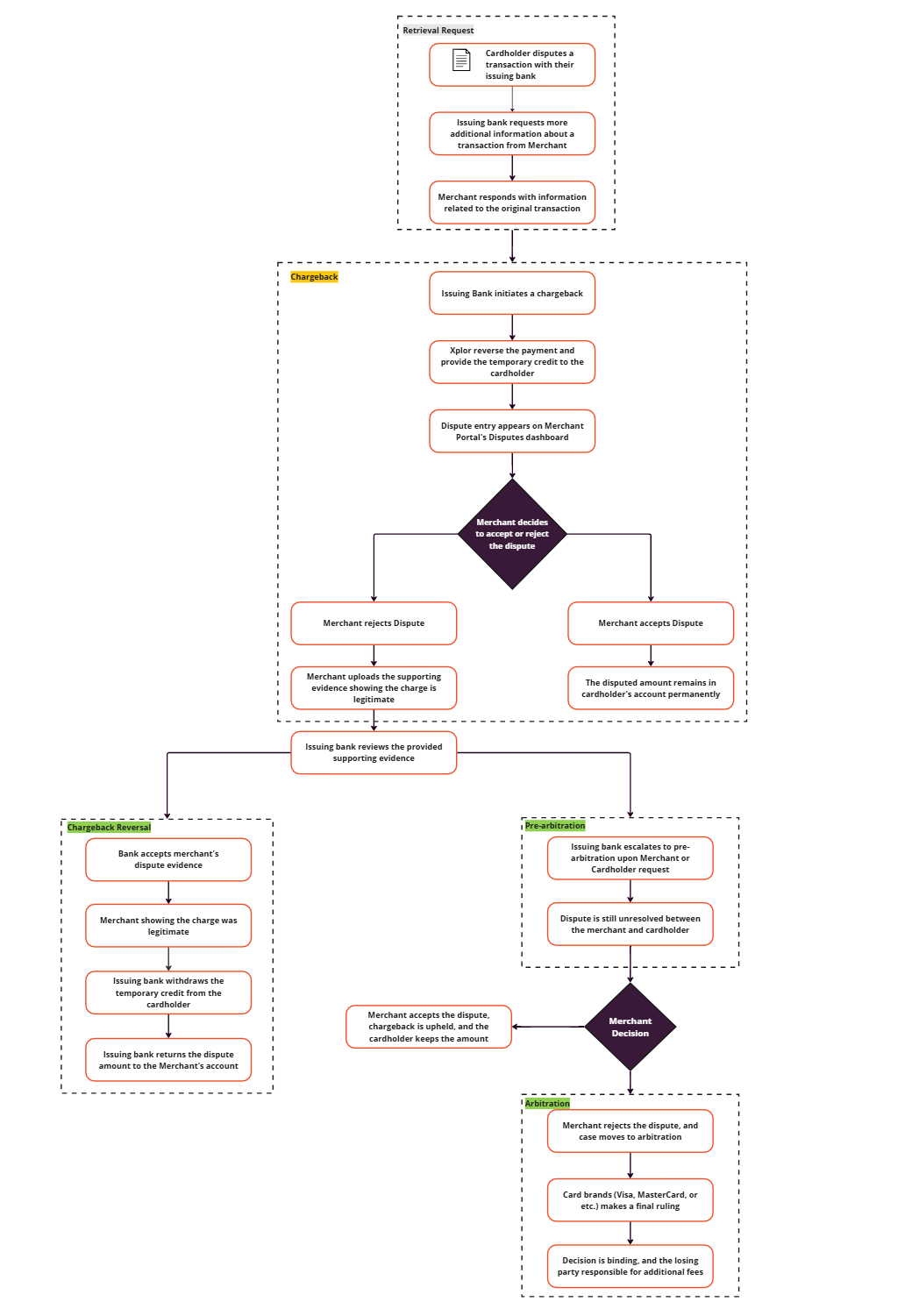
A dispute begins when a cardholder questions a transaction with their issuing bank. This initial inquiry prompts an investigation but does not yet involve a financial reversal. Common reasons for disputes include:
* Unrecognized charges on the cardholder's statement
* Dissatisfaction with products or services
* Claims of undelivered merchandise
* Subscription cancellations not honored
* Suspected fraud or unauthorized transactions
{% hint style="warning" %}
**Note:** Visa does not support retrieval requests and proceeds directly to chargebacks.
{% endhint %}
If managed properly during this early stage, disputes can often be resolved without escalating to chargebacks, avoiding unnecessary costs and administrative burden.
#### **Chargebacks**
When a dispute progresses to a financial reversal, it becomes a **chargeback**. This means the issuing bank has temporarily credited the cardholder’s account and reversed the transaction amount from the merchant.
At Xplor Pay, the following actions are triggered:
* Xplor Pay reverses the payment and applies temporary credit to the cardholder’s account.
* When a chargeback is received, the merchant is notified and can access dispute details either through the [Merchant Portal](https://docs.xplorpay.com/merchant-portal/guides/disputes-management) or via their integrated system using the [Disputes API](https://docs.xplorpay.com/api-reference/api/disputes). New chargebacks appear with a status of New Activity.
* A notification email is sent to the merchant’s business email address on file.
Chargebacks have financial and reputational consequences for merchants:
* Immediate withdrawal of the disputed amount from the merchant’s account.
* Additional processing fees may apply.
* Chargebacks impact the merchant’s processing history and dispute ratio.
* Excessive chargebacks may trigger account reviews or potential termination.
#### **Representments**
A representment is the merchant’s formal response to a chargeback, aimed at recovering the disputed funds. Merchants can either accept or challenge the chargeback:
* **Accepting** the chargeback results in the dispute amount being permanently credited to the cardholder.
* **Rejecting** the chargeback requires the merchant to submit supporting evidence to the issuing bank, including receipts, delivery confirmations, or correspondence that proves the charge was legitimate.
Key steps for successful representment include:
* Addressing the specific reason with a clear narrative.
* Submitting complete and formatted documentation.
* Meeting tight submission deadlines (typically 7–30 days based on card network rules).
If the issuing bank **accepts** the evidence, the chargeback is reversed, and the funds are returned to the merchant. If the issuing bank **rejects** the evidence, the chargeback is finalized, and the cardholder retains the credited amount.
#### **Pre-Arbitration and Arbitration**
If either party (merchant or cardholder) challenges the outcome of a representment, the dispute may be escalated to:
* **Pre-Arbitration:** An additional review phase where both parties re-evaluate their positions.
* **Arbitration:** A final decision made by the card network, which may include additional fees imposed on the losing party.
---
# Agent Instructions
This documentation is published with GitBook. GitBook is the documentation platform designed so that both humans and AI agents can read, navigate, and reason over technical content effectively. Learn more at gitbook.com.
## Querying This Documentation
If you need additional information that is not directly available in this page, you can query the documentation by asking a question.
Perform an HTTP GET request on the following URL with the `ask` and `goal` query parameters:
```
GET https://docs.xplorpay.com/merchant-portal/guides/disputes-management/understanding-dispute-process.md?ask=&goal=
```
`ask` is the immediate question: it should be specific, self-contained, and written in natural language.
`goal` is what the user is ultimately trying to achieve, the reason they need the answer. Sharing it helps GitBook give you a better, more relevant answer. A goal is most helpful when it describes the outcome the user wants rather than restating the question. For example, with `ask=how do I create an API token`, a goal like `automate deployments from our CI pipeline` lets GitBook tailor the answer to that use case.
The response will contain a direct answer to the question and relevant excerpts and sources from the documentation.
Use this mechanism when the answer is not explicitly present in the current page, you need clarification or additional context, or you want to retrieve related documentation sections.